
Spray Foam Insulation in Manhattan, KS & the Flint Hills
Spray foam seals a building the way batts and blown-in fiber can't — it expands into every gap, crack, and stud bay, then stays put. We install both open-cell and closed-cell foam across the Flint Hills, from farmhouse attics to metal shop roof decks.
What Spray Foam Insulation Actually Does
Spray foam starts as two liquid chemicals that mix together at the tip of a spray gun. Once they hit a surface, they expand — usually somewhere between 30 and 100 times their liquid volume — and harden within seconds. That expansion is what lets the foam fill every irregular gap in a stud bay, rafter, or rim joist, instead of just draping over the surface the way a fiberglass batt does.
The foam also works as an air barrier at the same time it's insulating. That's the part most other insulation types don't do at all. A fiberglass batt can slow heat transfer through a wall, but air can still move around, over, and through it. Spray foam closes that gap, which is a big part of why a sprayed attic or wall stops drafts that batts never do.
Open-Cell vs. Closed-Cell Spray Foam
We use both, depending on where the foam is going and what problem we're solving. Here's the plain difference between them.
Open-Cell Spray Foam
Softer and spongier than closed-cell, with cells that stay open — which is why it weighs less and costs less per board foot.
- R-value About R-3.5 to R-3.7 per inch
- Texture Soft, spongy
- Moisture Lets some vapor pass through
- Good for Interior walls, attics, sound dampening
Closed-Cell Spray Foam
Dense and rigid, with cells that are sealed shut — which is what gives it a higher R-value per inch and real structural strength.
- R-value About R-6 to R-7 per inch
- Texture Rigid, dense
- Moisture Blocks water vapor
- Good for Rim joists, crawl spaces, pole barns, roof decks
Where We Install Spray Foam Around the Flint Hills
Every building loses heat and moisture differently. We look at how yours is built before recommending a foam type and thickness — here's where we do this work most often.
Residential Spray Foam
Attics, exterior walls, rim joists, and additions in Manhattan-area homes, insulated and air-sealed in the same step.
Learn More →Commercial Spray Foam
Offices, shops, and storage buildings insulated to hold a set temperature without the HVAC system running constantly.
Learn More →Pole Barns & Ag Buildings
Shops, machine sheds, and livestock barns, where condensation dripping off a bare metal roof is the real problem, not just heat loss.
Learn More →Crawl Space Encapsulation
Sealed and insulated crawl spaces that stop cold floors and the musty smell that comes with an open-vent crawl space.
Learn More →Building new? See our new construction insulation services →
See a Recent Job From Start to Finish
This is a vaulted-ceiling loft space before and after we sprayed it — same room, same framing, before the foam gun ever came out and after the job was finished.
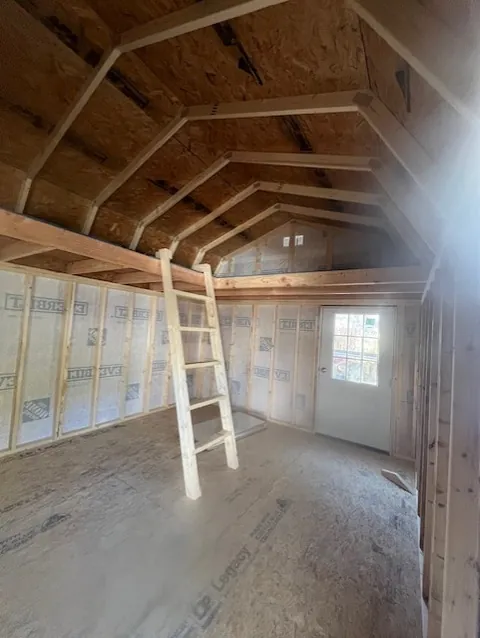
Framed and Ready for Foam
Bare stud walls, exposed rafters, and a plywood subfloor. This is what we're looking at before any spray foam goes on — every stud bay and rafter gets checked for wiring and blocking first.
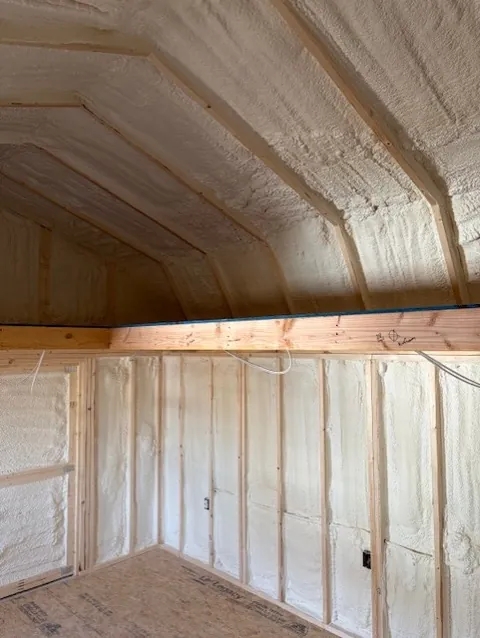
Walls and Ceiling Fully Sealed
Closed-cell foam sprayed across every wall stud bay and up the entire vaulted ceiling — wall to wall, with no gaps left along the studs, top plate, or ridge beam.
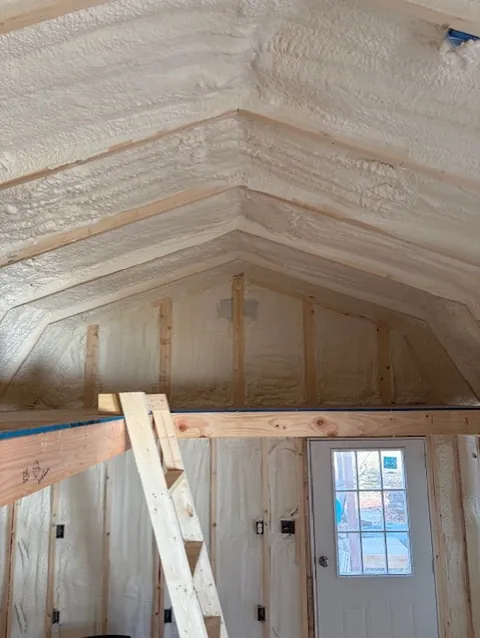
Every Angle of the Roofline Covered
Vaulted ceilings have more odd angles than a flat attic, which means more chances to miss a spot. This close-up shows foam carried all the way up into the peak, not just the flat sections.
What to Expect on Install Day
-
1
Walkthrough & Prep
We check for wiring, plumbing, and anything else that needs to be masked off before spraying starts.
-
2
Spraying
Foam goes on in careful passes, building up to the target thickness for the R-value your job calls for.
-
3
Cure & Re-Entry Time
Spray foam needs time to fully cure before anyone should be in the space without ventilation. We follow manufacturer re-entry times on every job, not a guess.
-
4
Trim & Cleanup
Excess foam gets trimmed flush wherever it needs to sit behind drywall or trim, and we clear the site before we leave.
Spray Foam Insulation: Quick Answers
Is spray foam insulation safe?
Can you spray foam over existing insulation?
How much spray foam insulation do I need?
Will spray foam void my roof warranty?
Is spray foam insulation guaranteed?
Ready for a Tighter, More Efficient Building?
Tell us a little about your project and we'll call you back — usually the same business day.